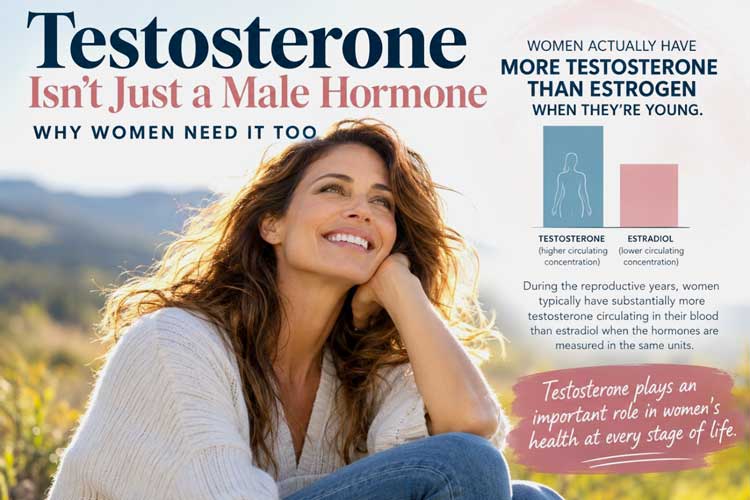
Testosterone Isn't Just a Male Hormone: Why Women Need It Too



Blog and News Updates
Welcome to Dr. Anderson's Blog. Check back often for new information, recipes and more!
When women think about hormones, we usually hear about estrogen and progesterone.
But there’s another important hormone that often gets left out of the conversation: testosterone.
This surprises many women: during the reproductive years, women typically have substantially more testosterone circulating in their blood than estradiol when the hormones are compared using the same units of measurement.
Testosterone isn't simply a “male hormone.” It is a normal and important female hormone produced primarily by the ovaries and adrenal glands.
Yet when women enter perimenopause and menopause, hormone replacement conversations frequently focus almost entirely on estrogen and progesterone. Testosterone may never even be discussed.
That's worth changing.
Testosterone receptors are found throughout the female body, and testosterone contributes to much more than sexual desire. Healthy androgen levels can play a role in:
Testosterone levels generally decline with age, and ovarian production can also change substantially after surgical removal of the ovaries.
Yet many women who have their hormones evaluated have never had testosterone discussed at all.
I recently had a patient ask essentially this question after we discussed testosterone.
She had received care for her hormones before, but no one had explained the role testosterone plays in women's health. She was understandably surprised to discover that testosterone is a normal female hormone—and that younger women actually have higher circulating concentrations of testosterone than estradiol when measured in the same units.
Unfortunately, she isn't the only woman who has never been told this.
Estrogen and progesterone are extremely important, but they aren't the entire hormonal picture.
A woman may be taking estrogen and progesterone and still say:
“I just don't feel like myself.”
She may notice decreased sexual desire, loss of strength or muscle mass, reduced energy, or other changes that began around perimenopause or menopause.
These symptoms aren't specific to testosterone deficiency and can have many other causes, including thyroid disorders, anemia, sleep problems, medications, stress, depression, nutritional deficiencies, and other medical conditions.
That's exactly why hormone treatment shouldn't be one-size-fits-all.
No.
Testosterone therapy isn't appropriate for every woman, and simply having a lower laboratory value doesn't automatically mean someone needs treatment. Symptoms, medical history, medications, other hormone levels, and potential risks all matter.
When testosterone is appropriate, dosing for women is very different from dosing for men. Too much can cause acne, increased facial or body hair, scalp hair loss, and other androgenic effects. Treatment should be individualized and monitored.
But testosterone deserves to be part of the conversation when evaluating a woman's hormonal health—particularly when symptoms persist despite otherwise appropriate care.
If you're taking hormone replacement but still don't feel like yourself—or you've never had a comprehensive discussion about testosterone—it may be time to look at the bigger hormonal picture.
At Anderson Natural Medicine, we evaluate your symptoms, medical history, and appropriate laboratory testing to determine what may be contributing to how you feel and whether changes to your treatment should be considered.
Women have testosterone too—and much more of it than many women realize. It shouldn't automatically be left out of the hormone conversation.
Schedule an appointment with Anderson Natural Medicine for an individualized hormone evaluation and treatment discussion.
Your hormones work together. Your treatment plan should consider the whole picture, too.